
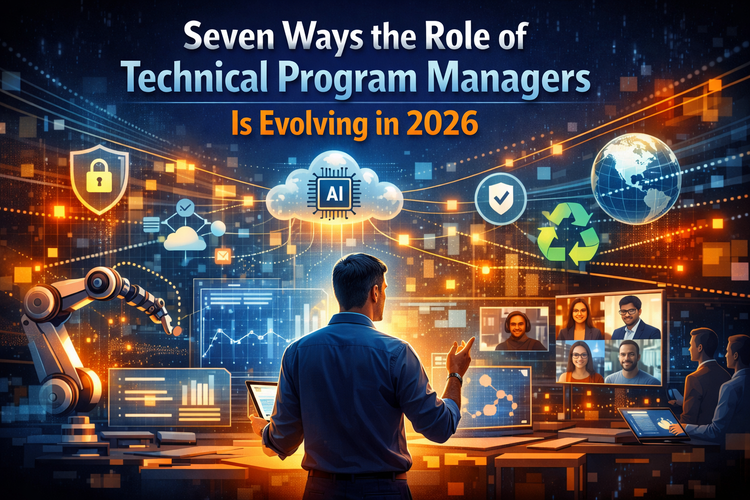
Seven Ways the Role of Technical Program Managers is Evolving in 2026
In 2026, the role of the Technical Program Manager (TPM) is undergoing a meaningful transformation. Driven by rapid technological advancement and increasingly complex organizational structures, TPMs are no longer viewed solely as delivery coordinators. They are emerging as strategic partners who combine technical depth, business acumen, and cross-functional leadership to drive measurable outcomes.
Today’s TPMs are expected to engage deeply with engineering teams, contribute to architectural discussions, and align technical initiatives directly with business objectives. At the same time, they are leveraging artificial intelligence and automation to enhance decision-making, manage risk proactively, and streamline execution. This evolution reflects both the maturity of the role and the growing reliance organizations place on TPMs to deliver value in highly dynamic environments.
Below are seven key ways the TPM role is changing in 2026.
1. Deep Technical Fluency Is Essential
The modern TPM is expected to possess strong technical fluency. While hands-on coding is not required, a solid understanding of system architecture, cloud platforms, AI pipelines, and DevOps practices is now foundational. This level of technical depth enables TPMs to identify risks early, ask informed questions, and meaningfully contribute to design and execution discussions.
As systems become more interconnected, TPMs who understand how components interact are better positioned to anticipate dependencies and prevent downstream failures.
2. Focus on Outcomes Rather Than Process
Historically, TPM success was often measured by adherence to process and delivery timelines. In 2026, the emphasis has shifted decisively toward outcomes. Organizations increasingly expect TPMs to tie programs to business impact, such as improvements in reliability, customer experience, or revenue growth.
This shift requires TPMs to think beyond task completion and adopt a product-oriented mindset, using metrics and key performance indicators to define and measure success.
3. Mastery of AI-Driven Program Management Tools
Artificial intelligence has become a core component of the TPM toolkit. AI-powered platforms now assist with dependency mapping, risk prediction, resource optimization, and real-time reporting. These tools allow TPMs to move from reactive issue management to proactive program leadership.
Industry data indicates that more than half of organizations now rely on AI for some aspect of program planning, underscoring the importance of TPMs who can effectively integrate these technologies into their workflows.
4. Expanded Cross-Organizational Influence
TPMs in 2026 operate far beyond the boundaries of engineering teams. They are responsible for aligning stakeholders across product, design, marketing, legal, security, and compliance functions. As a result, influence without direct authority has become a defining competency.
Effective TPMs excel at communication, negotiation, and alignment, ensuring that all teams understand how their work contributes to shared goals and timelines.
5. Security and Compliance as Core Responsibilities
With increasing regulatory scrutiny and heightened awareness of data privacy and AI ethics, TPMs are now expected to incorporate security and compliance considerations into program planning from the outset. Familiarity with frameworks and regulations such as SOC 2, GDPR, and HIPAA is no longer optional.
By proactively addressing these requirements, TPMs help prevent late-stage delays and ensure programs can launch with confidence.
6. Remote-First Leadership Capabilities
While hybrid work models continue to evolve, many TPMs remain responsible for leading distributed teams across multiple time zones. Success in this environment requires strong remote leadership skills, including clear communication, trust-building, and disciplined execution.
TPMs who can maintain momentum and alignment in a remote-first context are increasingly valuable to global organizations.
7. Emphasis on Sustainability and Ethical Technology
Organizations are placing greater emphasis on responsible technology delivery. TPMs are now expected to consider the environmental, social, and ethical implications of their programs. This may include selecting energy-efficient infrastructure, ensuring AI systems are explainable, or evaluating the broader impact of technical decisions.
Responsible delivery is becoming an integral part of the TPM role, not an afterthought.
Conclusion
The Technical Program Manager of 2026 is a strategic leader, technical advisor, and organizational connector. While execution excellence remains important, the role now demands broader vision, deeper technical understanding, and stronger alignment with business outcomes.
For TPMs, this evolution presents both a challenge and an opportunity. Those who remain curious, invest in continuous learning, and embrace their expanding influence will find themselves at the center of how organizations transform ambitious ideas into tangible results.


Member discussion